
Breakthrough Advertising Summary: Why Most Copy Fails Before It Is Written
Most copy does not fail because the words are weak.
It fails because the marketer is trying to do something copy cannot do. He is trying to create desire from scratch. He is trying to force attention where no appetite exists. He is trying to make the market care before he has understood what the market already cares about.
That is the uncomfortable idea at the center of Breakthrough Advertising. The copywriter’s job is not to manufacture desire. It is to find desire that already exists, understand its current shape, then channel it toward a product with enough force, clarity, and believability that buying becomes the natural next step.
This is why Eugene Schwartz’s book still matters. It is not really a book about clever headlines. It is a book about markets, timing, buyer psychology, competitive saturation, belief, mechanism, and the difficult art of saying the right thing to the right market at the right stage of awareness.
The Old Seller Scorecard
Difficulty: 9/10
Practicality: 10/10
Timelessness: 10/10
Re-read Value: 10/10
Best For: Copywriters, marketers, founders, offer owners, and direct-response advertisers
Main Topic: Market desire, buyer awareness, market sophistication, and advertising strategy
Overall Verdict: One of the deepest books ever written on advertising because it explains the strategic conditions that determine whether copy can work before a word is written. Dense and dated in its examples, but exceptionally valuable for serious marketers and copywriters operating in competitive markets.
Why Breakthrough Advertising Still Matters
Most copywriting books teach you what to write. Breakthrough Advertising teaches you what to diagnose before you write.
That difference matters. A headline is not a decorative line placed above an offer. It is a strategic response to a market condition. The same claim can work brilliantly in one market and die completely in another, not because the words changed, but because the market’s awareness, sophistication, and belief structure changed.
Schwartz understood something many modern marketers still ignore: markets are not blank slates. They have history. They have memories. They have disappointments. They have heard previous promises. They have tried alternatives. They have become skeptical in very specific ways.
That is why the book survived. It gives marketers a way to think through those conditions instead of blindly copying formulas. It explains why “big promise” copy works in some markets, why it fails in others, why mechanisms become necessary, why proof must evolve, and why the same audience needs different messages as competition increases.
The examples are dated. The principles are not. Today’s landing pages, email campaigns, YouTube ads, VSLs, webinars, product launches, and sales letters still live or die by the same questions Schwartz was asking: What does this market already want? How aware are they? How many promises have they already heard? What do they believe? What do they doubt? What mechanism would make this claim feel new and credible?
The Core Idea Behind Breakthrough Advertising
The core idea is simple, but most marketers violate it constantly: copy cannot create desire. It can only channel desire that already exists.
A market is born when a private want becomes widespread enough to support profitable selling. People already want status, relief, health, beauty, recognition, control, certainty, achievement, security, speed, or escape. The advertiser does not invent these forces. He identifies them, chooses the strongest one his product can legitimately satisfy, and focuses it onto the product.
From there, the book becomes a system. First, identify the mass desire. Second, understand the prospect’s state of awareness. Third, measure the market’s level of sophistication. Fourth, choose the claim, mechanism, proof, and structure that match that exact market condition.
This is why Breakthrough Advertising is harder than most copywriting books. It does not give you a bag of tricks. It gives you a diagnostic model. And once you understand that model, you stop asking, “What headline sounds good?” and start asking, “What does this market need to believe next?”
The 7 Most Valuable Lessons From Breakthrough Advertising
1. Copy Does Not Create Desire, It Channels It
This is the foundation of the book.
Schwartz argues that desire comes from the market, not from the copywriter. People already carry hopes, fears, frustrations, ambitions, and cravings. The copywriter’s work is to connect one of those desires to a product.
This destroys a lot of bad marketing thinking. If nobody wants the outcome, stronger copy will not save the offer. If the market does not feel the problem, louder ads will not solve it. If the product is fighting against a dominant trend, cleverness becomes expensive self-deception.
For a founder or marketer, the application is direct: before writing the page, identify the strongest existing desire the offer can satisfy. Do not start with product features. Do not start with what you want to say. Start with what the market already wants badly enough to act on.
Schwartz uses the automotive market to make this point. When buyers wanted longer, lower, wider cars, campaigns that fought that desire failed. When horsepower became the dominant appeal, brands that aligned with it won. The lesson is not about cars. It is about market momentum. You can ride it, redirect it, or get crushed by it.

p. 16/217
2. The Headline Must Match the Prospect’s State of Awareness
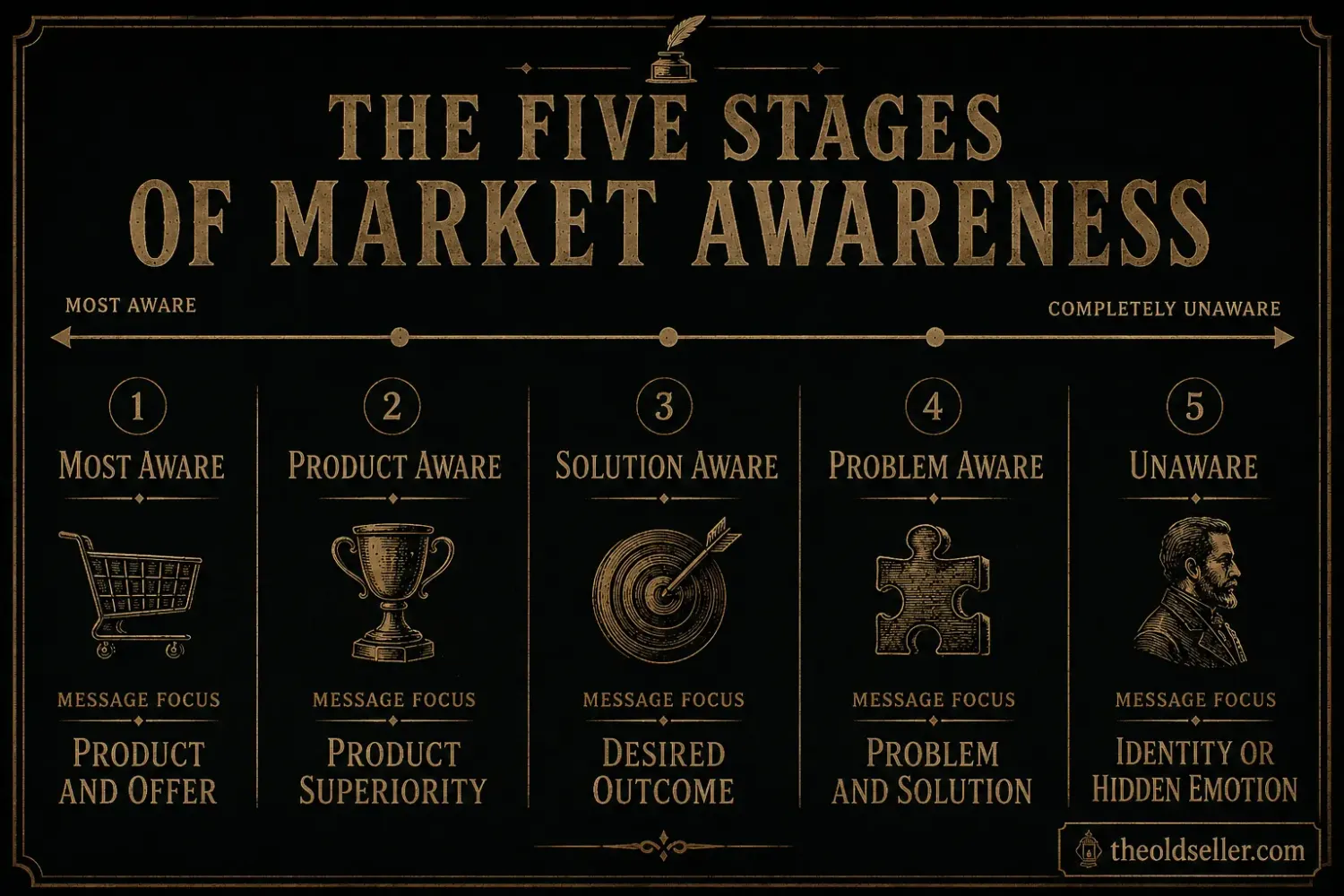
A prospect can be fully aware of your product, aware of the solution, aware only of the problem, dimly aware of a desire, or completely unaware.
Each stage requires a different kind of headline.
If someone already knows the product and wants it, a price or offer headline may work. If they know the problem but not the solution, the headline must name or dramatize the problem. If they are unaware, direct product claims may fail because the prospect has no mental category for them yet.
This is where many marketers get lazy. They write one kind of copy for every market. Usually, they default to either a direct promise or a clever curiosity hook. Both can work. Both can also fail miserably when used at the wrong awareness level.
For landing pages, this changes the entire page strategy. Cold traffic often needs problem crystallization before product explanation. Warm traffic may need differentiation. Retargeting traffic may need proof or urgency. Existing buyers may only need a clear offer.
The book’s awareness model is one of its most famous contributions because it explains why copy is contextual. There is no universally strong headline. There is only a headline that fits the buyer’s current mental distance from the purchase.
3. Market Sophistication Determines How Much You Must Evolve the Claim
A market becomes sophisticated when it has heard too many similar promises.
At the beginning, a simple direct claim can work because the promise feels new. “Lose weight.” “Grow hair.” “Make more money.” “Get whiter teeth.” But after competitors repeat the same promise, the market stops believing it. The promise becomes noise.
Schwartz’s answer is not to scream louder. It is to evolve the claim.
In a less sophisticated market, you can lead with the result. In a more sophisticated market, you need a mechanism. You need to explain why this product can deliver the result when others have failed. As the market becomes even more saturated, the mechanism itself must become more specific, more unique, and more believable.
This is extremely relevant today. Most online markets are already sophisticated. Weight loss, investing, productivity, dating, fitness, marketing, AI tools, coaching, supplements, SaaS, and business education are full of repeated claims. “Get more leads” means almost nothing. “Grow your audience” means almost nothing. “Save time with AI” is already tired.
The practical move is to ask: what has this market already heard? What promises are they numb to? What mechanisms are now overused? What new explanation would make the desired result believable again?
That is why great copy often starts with market research, not writing.
4. The Physical Product Does Not Sell, The Functional Product Does
Schwartz makes a sharp distinction between the physical product and the functional product.
The physical product is the thing itself: the book, supplement, software, course, device, service, or object. The functional product is what it does for the buyer. That is what people actually pay for.
A buyer does not want a course. He wants competence, speed, confidence, money, clarity, status, or reduced risk. He does not want a CRM. He wants fewer lost deals, cleaner follow-up, better visibility, and more control over sales activity. He does not want an audiobook. He wants to absorb hard books while walking, driving, training, or working without spending weeks annotating the original.
This lesson matters because weak marketers sell the container. Strong marketers sell the performance.
But Schwartz goes further. The physical product is not useless. It becomes proof. The features, materials, process, ingredients, structure, or technical details help justify the performance claim. They make the benefit believable.
For copywriters, this is a clean operating rule: lead with the dominant performance, then use the physical facts to prove, sharpen, and support it. Do not bury the buyer under features before you have made him care about the outcome.
5. The Strongest Copy Intensifies Desire Before It Asks for Action
Desire is not binary. It has intensity.
A prospect can vaguely want something, or he can feel the desire so sharply that price, skepticism, and inertia begin to lose power. One of the copywriter’s jobs is to intensify the desire until action feels justified.
Schwartz describes advertising as the literature of desire. That sounds poetic, but the operational meaning is practical. Copy gives desire a shape. It makes the vague specific. It turns a blur into a picture. It helps the prospect feel the cost of staying where he is and the attraction of moving toward the promised result.
This is why strong sales pages do not merely state the benefit once. They expand it. They visualize it. They show the before and after. They connect it to daily frustrations. They make the hidden emotional stakes visible.
For example, a productivity product should not only say “get more done.” That is too flat. It should make the reader feel the pain of scattered attention, unfinished projects, wasted mornings, and the quiet humiliation of knowing he is capable of more but not executing. Then it should show the specific mechanism that restores control.
The danger is exaggeration. Intensification is not lying. It is not fake pain agitation. Done properly, it is the honest sharpening of a real desire already present in the market.
6. Identification Can Reach Markets That Direct Claims Cannot
Some markets do not respond to direct promises because the problem is hidden, embarrassing, socially uncomfortable, or not yet clearly understood.
In those cases, the copywriter may need to begin with identification. Instead of saying, “Buy this product,” the copy defines the reader’s state of mind. It gives words to something the prospect already feels but has not articulated.
This is one of the more subtle parts of the book.
Schwartz gives examples where direct claims would have been too narrow or too unacceptable. The “University of the Night” example expands the market for correspondence courses by speaking to the hidden dream of self-education and upward movement. The deodorant example begins with a socially acceptable image before leading into an uncomfortable problem. The Marlboro example projects masculine identity visually instead of stating it bluntly.
Modern marketers should pay attention to this. Many offers are not blocked by lack of desire. They are blocked by shame, confusion, skepticism, or identity tension. The prospect may want the outcome but reject the crude way marketers talk about it.
This applies heavily to coaching, health, money, dating, education, and status-driven markets. Sometimes the winning angle is not the loudest promise. It is the most accurate mirror.
7. A Breakthrough Comes From Analysis, Not Formula Copying
Schwartz is hostile to formula worship.
Not because formulas are always useless, but because every formula is a solution to an old problem. Once the market, product, competition, or awareness level changes, copying the old solution can become dangerous.
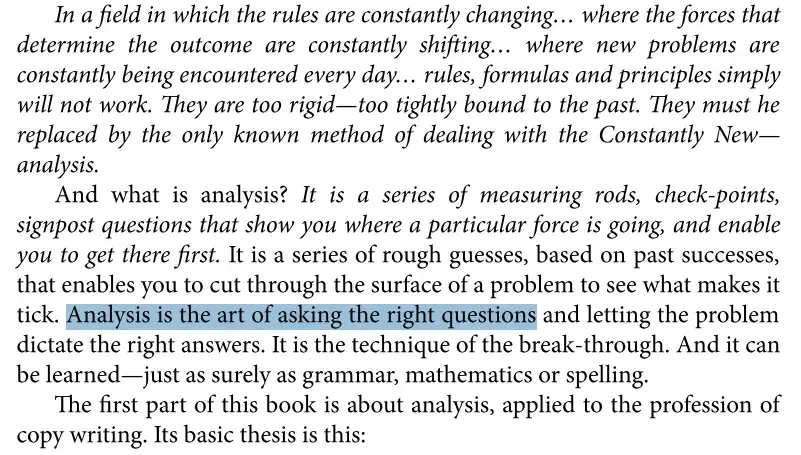
This is one of the reasons Breakthrough Advertising is still harder and more valuable than most copywriting material. It does not let the marketer hide behind templates. It demands analysis.
What is the desire? How strong is it? How many people share it? How aware is the market? How many competitors have made similar claims? What does the prospect believe? What does he doubt? What mechanism would make the claim credible? What image, proof, or identification would move him forward?
That is the real work.
For modern copywriters, this is the difference between “writing hooks” and building a message strategy. A hook may get attention. A strategy moves the prospect from his current belief state to the point where the product feels like the logical solution.
p. 11/217
The Old Seller Insight: This Is Really a Book About Market Timing
The shallow reading of Breakthrough Advertising is that it is a book about headlines.
That is wrong.
The deeper reading is that it is a book about timing. Not timing in the simple sense of launching on the right date, but timing in the psychological and competitive life of a market.
Every market has a stage. Every promise has a shelf life. Every mechanism eventually gets copied. Every proof element eventually becomes expected. Every audience moves from curiosity to belief to saturation to skepticism. The marketer’s job is to know where the market is now, not where it was when the winning control was written.
This is why Schwartz’s ideas remain so useful. He understood that advertising is not static. You are not speaking into a vacuum. You are entering an existing conversation shaped by previous products, previous ads, previous disappointments, and previous beliefs.
That is also why copying old winning ads is often stupid. You are copying the answer without copying the conditions that made the answer correct.
The real skill is not memorizing headlines. The real skill is diagnosing the market’s present condition and producing the next believable step. In a new market, that may be a direct claim. In a skeptical market, it may be a mechanism. In an unaware market, it may be identification. In a saturated market, it may be a new category, a new enemy, a new proof structure, or a new way to name the problem.
That is the book’s lasting intelligence. It teaches you to stop treating copy as wordplay and start treating it as market strategy.
Where People Get This Book Wrong
The first mistake is thinking “copy cannot create desire” means copy is weak.
Schwartz means the opposite. Copy is powerful precisely because it can harness forces much larger than itself. But it cannot invent those forces out of nothing. If the desire is absent, the copywriter is no longer advertising. He is educating, and education is slower, more expensive, and harder to make profitable.
The second mistake is treating awareness and sophistication as interesting theory rather than practical constraints. These are not academic labels. They determine what you can say first. They determine whether you should lead with the product, the promise, the problem, the mechanism, the proof, or the prospect’s identity.
The third mistake is reducing the book to “write bigger promises.” That is a dangerous misread. Schwartz does care about powerful promises, but he is equally concerned with believability. In sophisticated markets, the bigger claim often fails unless it is supported by a fresh mechanism, sharper proof, or a new way of framing the desire.
This matters because bad marketers use the book to become louder. Good marketers use it to become more accurate.
How These Ideas Apply Today
On landing pages, the awareness model should shape the entire above-the-fold section. If traffic is problem-aware, the hero should clarify the problem and desired outcome. If traffic is product-aware, the hero should emphasize differentiation, proof, or offer. If traffic is unaware, the page may need an editorial or identity-driven opening before introducing the product.
In paid ads, sophistication is often the difference between scaling and burning money. A market that has seen the same promise ten times will not respond to the eleventh version unless something changes. That change may be a new mechanism, a stronger demonstration, a more specific audience segment, or a sharper articulation of the pain.
In email marketing, Schwartz’s thinking helps sequence persuasion. You do not need to force the entire sale into one message. One email can intensify the desire. Another can introduce the mechanism. Another can handle skepticism. Another can show proof. Another can make the offer. This is simply the awareness journey spread across multiple touches.
In offer creation, the physical versus functional product distinction is critical. Many founders build features and then wonder why the market does not care. The better question is: what dominant performance does this offer deliver, and which existing desire does that performance satisfy most powerfully?
In positioning, the book teaches restraint. You cannot be everything at once. A product may satisfy several desires, but the ad usually needs one dominant appeal. The more crowded the market, the more important that choice becomes.
Is Breakthrough Advertising Worth Reading Today?
The challenge with Breakthrough Advertising is not deciding whether it is worth studying. The challenge is getting through it well enough to absorb what Eugene Schwartz is actually teaching.
The book is dense. Its language is older, its sentences are often long and layered, and some of its most important distinctions only become clear once you understand the pages around them. Most readers recognize a few famous concepts such as awareness or market sophistication, then move on before seeing how Schwartz connects them into a complete system for understanding desire, markets, offers, and buyer psychology.
That is why so many marketers own this book yet never fully apply it. They remember the labels, but miss the reasoning underneath them.
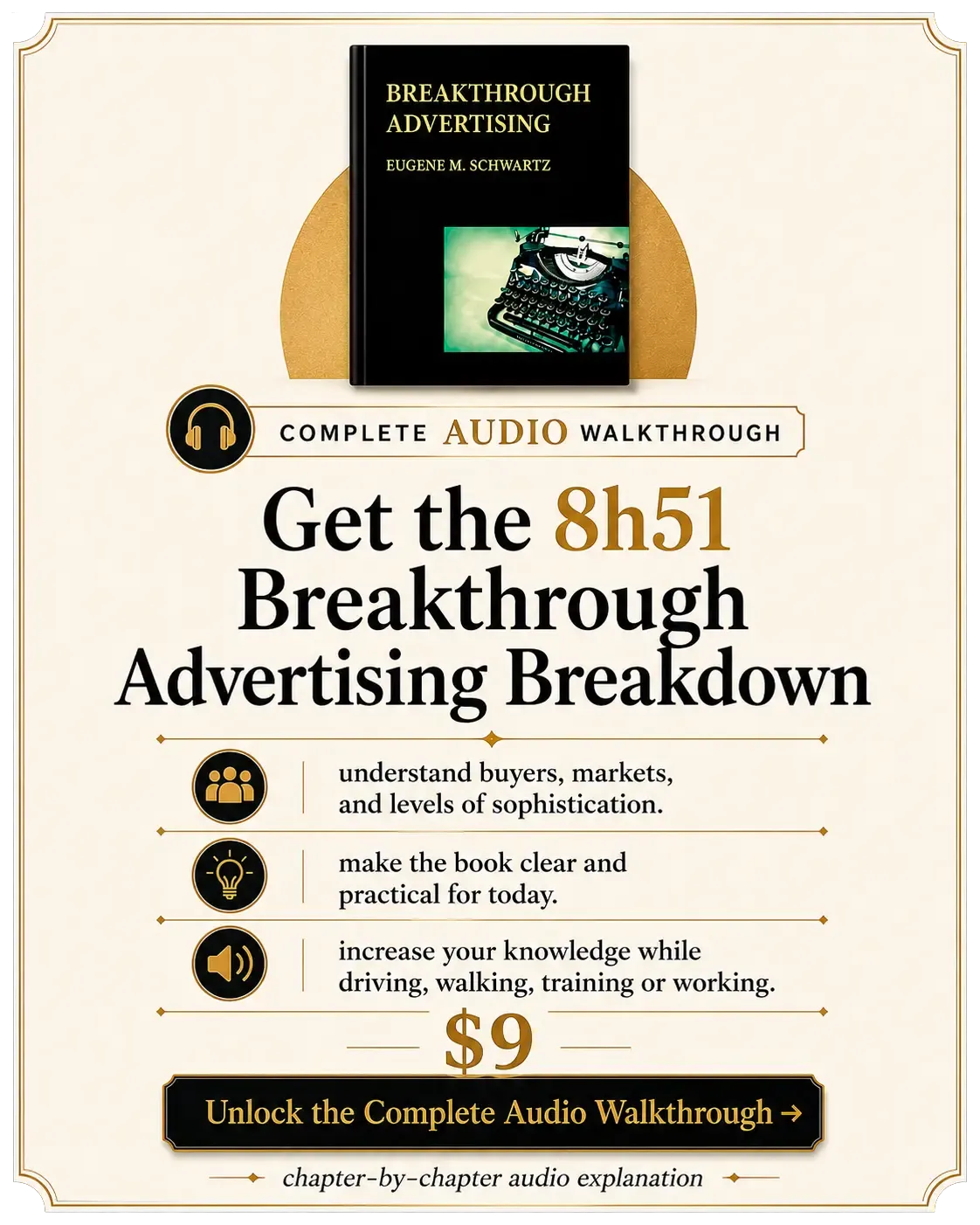
The complete Breakthrough Advertising audio walkthrough was made for people who want the depth of the book without spending weeks highlighting pages, rereading difficult passages, and trying to decode how each concept fits with the next.
It is a guided, chapter-by-chapter explanation of what Schwartz means, why each distinction matters, and how the ideas apply to modern copywriting, paid ads, offers, funnels, and positioning.
Before you read — listen for free
Hundreds of hours of marketing, sales and copywriting knowledge.
No account needed.
Every week, one book broken down into the single idea that could change how you sell.
The insight most readers miss without having to read a single page.

Every week, one book broken down into the single idea that could change how you sell.
The insight most readers miss without having to read a single page.