Moving to Outcomes Audio Walkthrough
Explore how outcome-based partnership marketing helps businesses move beyond paying for clicks and impressions, rewarding partners for actual sales and leads while building scalable, profitable customer acquisition channels.
GET THE FULL AUDIO →
Traditional digital advertising often forces businesses to compete for increasingly expensive clicks and impressions without guaranteeing meaningful results. In Moving to Outcomes, Robert Glazer and Matt Wool challenge this model, arguing that businesses should diversify their marketing investments through partnerships where compensation is tied to measurable outcomes such as sales, leads, and customer acquisition.
The book explains how affiliate marketing has evolved into a broader partnership model involving content publishers, influencers, referral programs, and brand-to-brand relationships. It examines four essential principles: cost-per-action compensation, transparency, genuine partner relationships, and real-time tracking and payment. Through practical business examples, the authors demonstrate how partnership automation can help companies scale their programs, align incentives, maintain control over acquisition costs, and build sustainable marketing relationships.
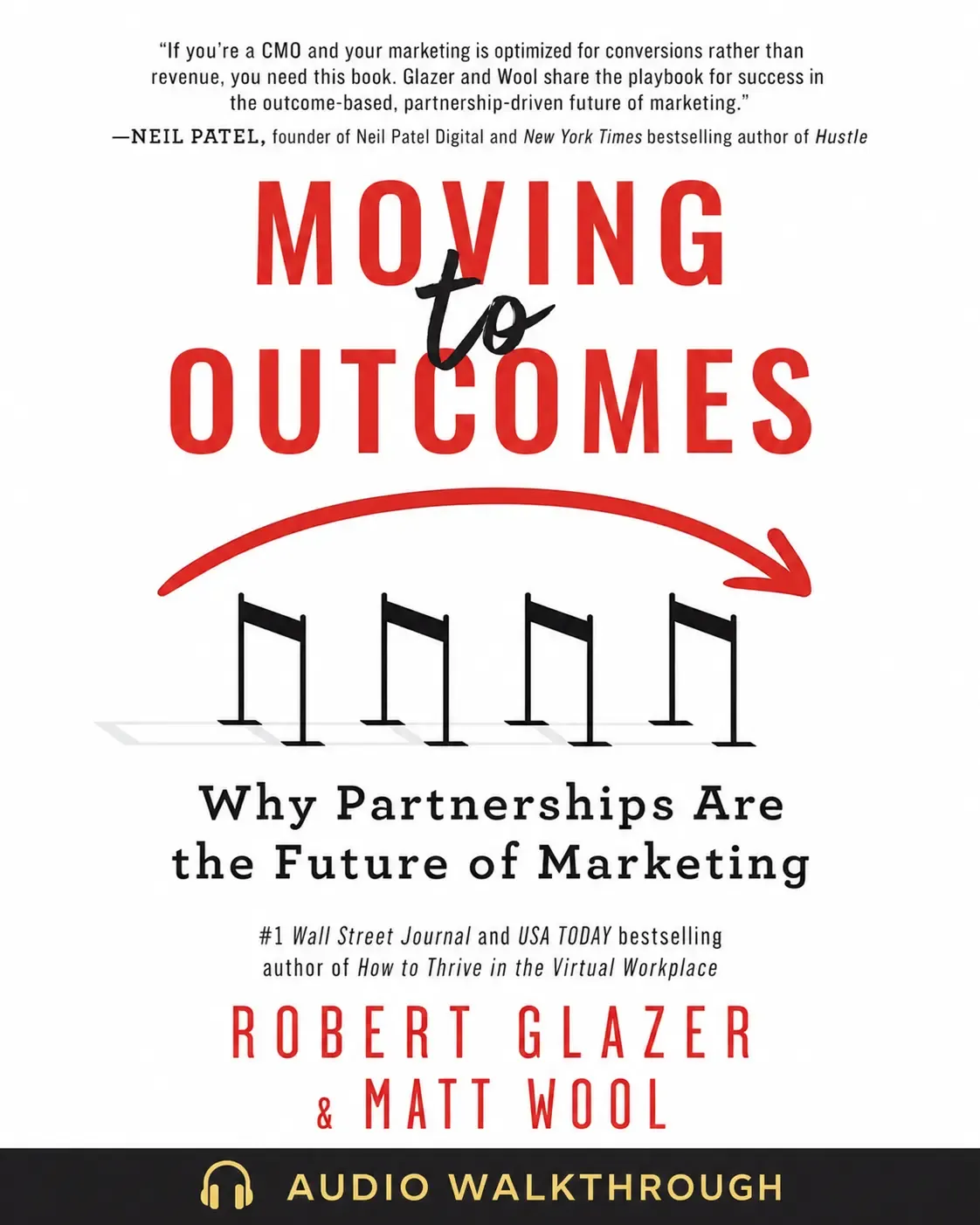
Moving to Outcomes Audio Walkthrough
Explore how outcome-based partnership marketing helps businesses move beyond paying for clicks and impressions, rewarding partners for actual sales and leads while building scalable, profitable customer acquisition channels.
Traditional digital advertising often forces businesses to compete for increasingly expensive clicks and impressions without guaranteeing meaningful results. In Moving to Outcomes, Robert Glazer and Matt Wool challenge this model, arguing that businesses should diversify their marketing investments through partnerships where compensation is tied to measurable outcomes such as sales, leads, and customer acquisition.
The book explains how affiliate marketing has evolved into a broader partnership model involving content publishers, influencers, referral programs, and brand-to-brand relationships. It examines four essential principles: cost-per-action compensation, transparency, genuine partner relationships, and real-time tracking and payment. Through practical business examples, the authors demonstrate how partnership automation can help companies scale their programs, align incentives, maintain control over acquisition costs, and build sustainable marketing relationships.
What You Get With the Full Audio
A complete, chapter-by-chapter Audio Walkthrough built to help you understand the book in depth and get more from every idea.
Complete Chapter-by-Chapter Coverage
Follow the book from beginning to end, with every chapter explained in sequence so important ideas are not lost along the way.
The Reasoning Behind the Ideas
Understand the context, logic, examples, and explanations behind the author’s ideas instead of only hearing isolated conclusions.
Built Specifically for Listening
Long-form audio designed to be easy to follow while walking, driving, training, commuting, or handling routine work.
Understand Ideas Well Enough to Use Them
Spend enough time with the concepts to see how they connect, what they mean, and where they can become useful in practice.
Hours of Focused Learning
Get the depth needed to properly explore the book instead of compressing its strongest ideas into just a few minutes.