The Boron Letters Summary: Why Great Copy Starts With a Starving Crowd
Most bad marketing fails before the copy is written.
Not because the headline is weak. Not because the button color is wrong. Not because the writer forgot a clever persuasion trick. It fails because the marketer is trying to create demand where there is no real hunger.
That is why The Boron Letters still matters. Gary Halbert was not interested in copy that sounds impressive. He cared about copy that gets orders, moves buyers, and makes money in the real world.
Written as letters from prison to his son Bond, the book is messy, personal, blunt, and sometimes dated. But underneath all of that is one of the clearest direct-response marketing educations ever written.
The Old Seller Scorecard
Difficulty: 5/10
Practicality: 9/10
Timelessness: 9/10
Re-read Value: 8/10
Best For: Copywriters, direct-response marketers, offer owners, list builders, funnel builders, media buyers
Main Topic: Direct-response marketing, market selection, offer creation, and persuasive copy
Overall Verdict: Essential but uneven. The book is raw and repetitive, but its core lessons on market hunger, buyer behavior, list quality, and offer strategy are still brutally relevant.
Why The Boron Letters Still Matters
Most copywriting books teach you how to write better words. The Boron Letters teaches you how to think before you write.
That difference matters. Halbert understood that copy is not magic. It cannot rescue a weak market, a vague offer, or an audience with no buying intent. His real obsession was not language. It was commercial reality.
The book survives because it teaches principles beneath the medium. Direct mail may feel old, but the logic is still alive in email marketing, Meta ads, Google search campaigns, landing pages, VSLs, affiliate funnels, and retargeting.
Halbert’s world was lists, envelopes, order coupons, and mailed promotions. Our world is pixels, attribution dashboards, ad accounts, email segments, and checkout pages. The tools changed. The buyer did not.
The lasting contribution of this book is simple: before you try to persuade, find out who already wants what you sell.
The Core Idea Behind The Boron Letters
The central idea of The Boron Letters is that marketing success comes from matching a strong offer with a hungry market, then communicating it clearly enough that people can act.
That is the spine of the book. Halbert does not start with headlines. He starts with markets. Who is buying? What are they buying? How recently did they buy? How much did they spend? What else are they likely to buy?
Only after that does copy matter.
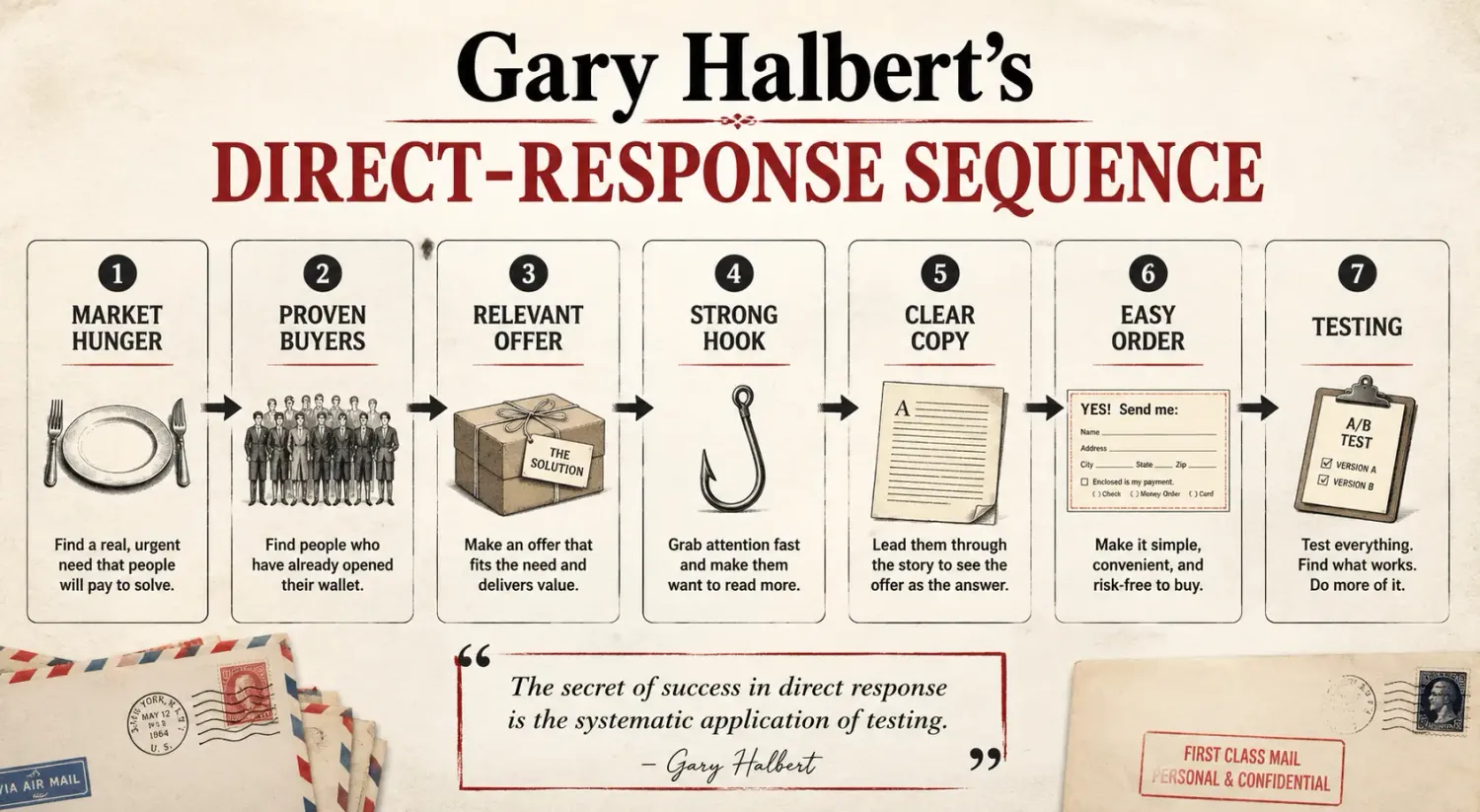
His system looks roughly like this: find market hunger, identify proven buyers, create a relevant offer, grab attention in a way that supports the sale, write clear copy, and make ordering easy.
The 7 Most Valuable Lessons From The Boron Letters
1. The best advantage is a starving crowd
Halbert’s most famous lesson comes from a hamburger stand example.
He asks his students what advantage they would want if they were competing to sell the most hamburgers. They choose better meat, better buns, cheaper prices, better location, and similar advantages.
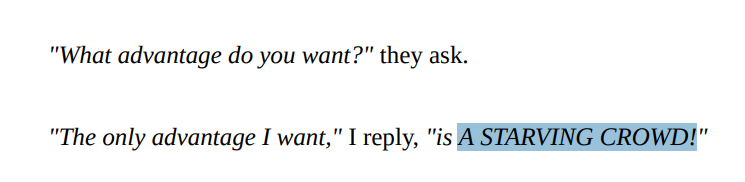
Halbert says they can have all of it. He only wants one advantage: a starving crowd.
p.51/208
This is the book’s main operating principle. Demand beats persuasion.
For marketers, this means you do not begin with “How do I make people want this?” You begin with “Who already wants this badly enough to pay?”
For copywriters, this is humbling. Great copy is powerful, but it is not stronger than market reality. A hungry market makes your copy work harder. A dead market makes even good copy look weak.
In modern business, the starving crowd might be a search term with buying intent, a competitor’s customer base, a painful niche problem, a high-converting affiliate category, or a segment of your email list that has already bought similar products.
2. Become a student of markets, not products
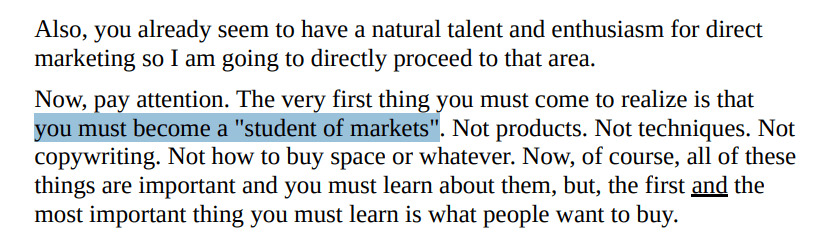
Halbert tells Bond that the first thing to learn is not products, techniques, copywriting, or media buying. The first thing is markets.
That line separates amateurs from operators.
A product-focused person asks, “Is my product good?” A market-focused person asks, “Who already buys this kind of thing, why do they buy it, and what would make them buy again?”
Halbert uses the SRDS list book as his research tool. He looks at lists of people who have bought diamonds, investment products, and other offers. He studies quantity, buyer behavior, and average unit of sale.
The modern equivalent is competitor research, ad libraries, search data, marketplace rankings, affiliate networks, review mining, email buyer segments, and paid traffic behavior.
The principle has not changed: do not guess what the market wants. Observe where money is already moving.
p. 45/208
3. What people do matters more than what they say
Halbert is ruthless about customer research. He does not trust what people claim. He trusts what they buy.
He gives the example of a beer company survey where people claimed to prefer premium beer, while actual sales showed they bought regular beer. The survey captured what people thought they should say. Sales captured reality.
He uses the same idea with the National Enquirer. People mocked it, but it sold massively. Public taste and private behavior are often different.
This is a major warning for founders.
A customer saying “great idea” is not validation. A comment saying “I would buy this” is not validation. A survey response is not validation unless it matches behavior.
Real validation is payment, repeat purchase, usage, retention, referrals, watch time, clicks, replies, checkout completion, or some other costly behavior.
For copywriters, this also changes research. Do not only collect what customers say in interviews. Study what they buy, what they avoid, what they complain about after buying, and what they purchase again.
4. List quality beats copy quality more often than people admit
One of the most practical sections of the book is Halbert’s breakdown of mailing lists.
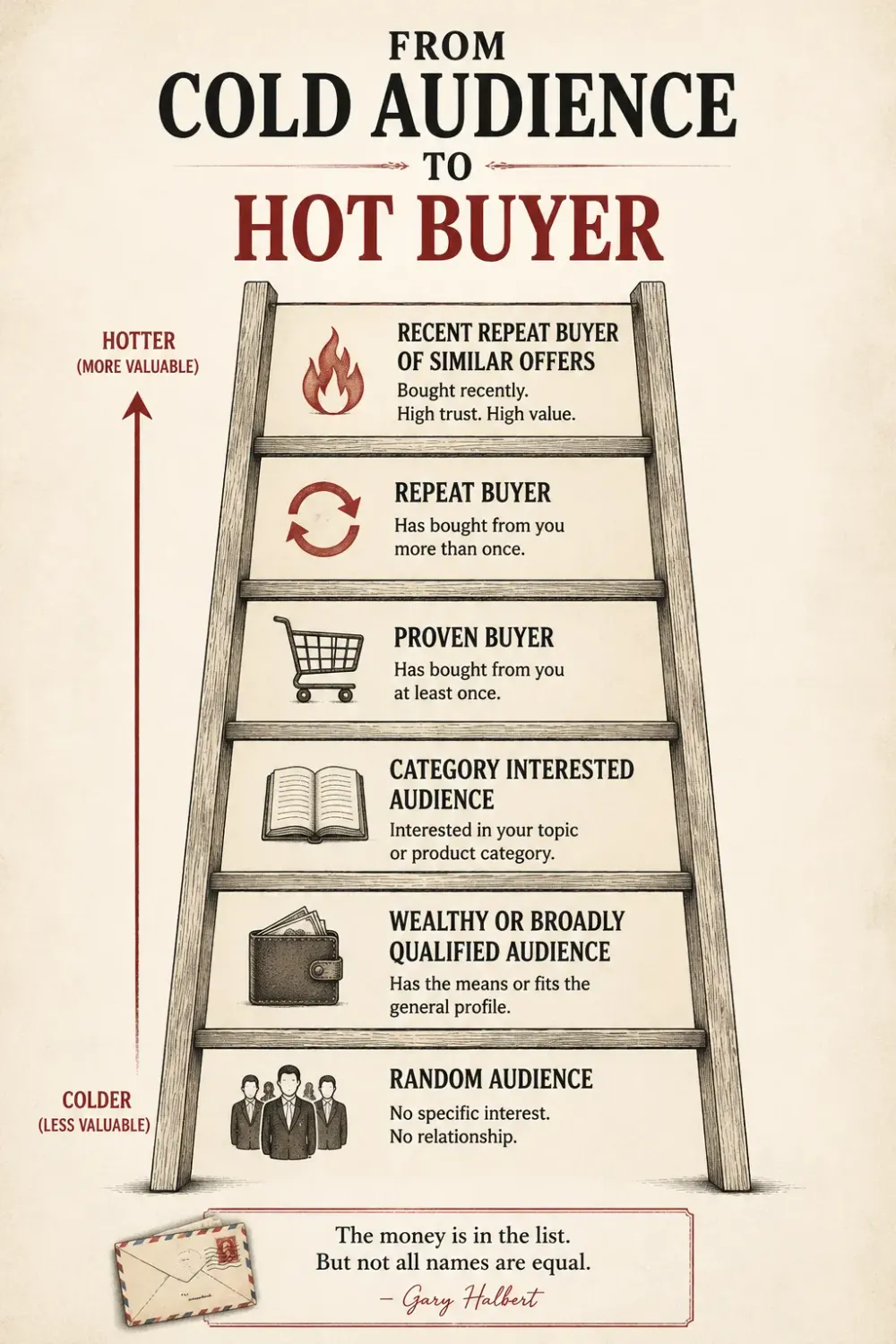
He walks through different ways to sell an investment book: random names from a phone book, wealthy areas, high-income professionals, mail-order buyers, people who bought investment books, repeat buyers, and recent repeat buyers.
Each step gets closer to the real buyer.
That is the direct-mail version of targeting and segmentation. The sharper the list, the less waste. The stronger the buying history, the better the odds.
This matters today because many marketers still treat audience selection casually. They obsess over creative while sending the offer to the wrong people.
In paid ads, list quality becomes audience intent. In email, it becomes segmentation. In funnels, it becomes traffic source. In sales, it becomes lead qualification.
A recent buyer of a similar product is more valuable than a random lead. A repeat buyer is more valuable than a one-time buyer. A buyer with a high average order value is more valuable than someone who only consumes free content.
5. Solve the concept before writing the copy
One of the biggest mistakes modern copywriters make is opening a blank document too early.
Halbert’s method is different. He spends time on market selection, buyer behavior, lists, successful promotions, attention devices, and offer logic before getting into the writing itself.
That is the right order.
The copy is not the strategy. The copy expresses the strategy.
Before writing a sales page, you should know the market, the pain, the desire, the proof, the mechanism, the offer, the reason to act now, and the first impression you want to create.
Halbert’s real estate promotion example shows this clearly. The idea of sending a roadmap and a baggie of dirt is not just “creative.” It is conceptual. It makes the opportunity tangible before the reader processes the full argument.
Modern version: a calculator, a teardown, a sample lesson, a diagnostic quiz, a before-and-after breakdown, or a screenshot can do more than another paragraph of claims.
6. Attention must be relevant, not just loud
Halbert liked attention grabbers. But he was not teaching gimmicks for their own sake.
The baggie of dirt works because it connects directly to the real estate offer. It is strange enough to interrupt attention, but relevant enough to deepen the sales message.
That distinction is important.
A random hook can get clicks and still hurt conversions. If the attention device attracts the wrong people or creates the wrong expectation, it becomes a liability.
Modern marketers make this mistake constantly. They write shocking hooks, curiosity headlines, or pattern interrupts that produce cheap attention but weak buyers.
Halbert’s lesson is sharper: the hook should not merely interrupt. It should pull the reader deeper into the buying argument.
For ads, that means the first line, image, or video opening must connect to the promise. For landing pages, the headline must frame the offer. For email, the subject line must create curiosity that the body can satisfy.
7. Copywriting skill comes from repetition, not passive reading
Halbert tells Bond to copy great ads by hand.
This advice is famous because it is simple, but most people misunderstand it. The point is not to perform a ritual. The point is to absorb structure.
When you copy a winning ad by hand, you start noticing how the lead opens, how the offer is introduced, how proof is layered, how objections are handled, how urgency is created, and how the order is asked for.
Reading a sales letter once gives you information. Copying it gives you pattern recognition.
For modern copywriters, this still works. Copy proven emails. Rewrite old advertorials. Break down VSL scripts. Study ads that have run for months. Read your copy out loud.
Skill is not installed by collecting frameworks. It is installed by reps.

p.136/208
The Old Seller Insight: Halbert Was Teaching Commercial Judgment, Not Just Copywriting
The shallow way to read The Boron Letters is to hunt for copywriting tricks.
That is understandable. Halbert was a legendary copywriter, so people look for headline secrets, closing formulas, layout tips, and order-pulling techniques.
But the deeper value of the book is commercial judgment.
Halbert is training Bond to see markets clearly. Who buys? Who lies? Who has money? Who buys by mail? Who buys repeatedly? What offer fits the audience? What proof makes the idea believable? What kind of attention supports the sale?
That is not just copywriting. That is business intelligence.
A copywriter without commercial judgment becomes a decorator of bad offers. He improves sentences while the underlying campaign remains weak. Halbert’s book pushes against that. He wants the writer to understand the economics of the promotion, not merely the wording.
This is why The Boron Letters is still useful in an age of AI-generated copy. Words are cheaper than ever. Judgment is not.
Where People Get This Book Wrong
The first mistake is thinking the book says copywriting is everything.
It does not. Halbert clearly values copy, but he puts market selection and list quality first. Better words matter after you are speaking to the right buyer with the right offer.
The second mistake is reducing “starving crowd” to “people with pain.” Pain is not enough. You need people who have demonstrated willingness and ability to buy.
The third mistake is thinking attention is the goal. Halbert’s attention devices are not random stunts. They are tied to the offer. That is why they sell instead of merely distracting.
Get these distinctions wrong and you end up with modern marketing nonsense: viral hooks for weak offers, survey-driven products nobody buys, and beautiful sales pages sent to cold audiences with no real intent.
How These Ideas Apply Today
For landing pages, Halbert changes what you optimize first. Before tweaking button copy, ask whether the page is built around a real buyer desire and a clear offer.
For paid ads, he forces you to care about buyer quality. Cheap clicks from the wrong people are waste. A smaller, more expensive audience with proven intent may be worth far more.
For email marketing, the list lesson is obvious. A broadcast to everyone is weaker than a relevant offer sent to a segment based on purchase history, interest, recency, or behavior.
For offer creation, the book pushes you toward specificity. If someone bought a copywriting product, the next offer should match that interest. If someone bought a psychology product, sell them the psychology expansion. Relevance compounds.
There is a natural connection here with Eugene Schwartz’s Breakthrough Advertising. Schwartz explains how advertising channels existing desire. Halbert shows how a direct-response operator finds that desire and turns it into orders.
Is The Boron Letters Worth Reading Today?
Yes, especially if you write copy, build funnels, sell information products, run paid ads, manage email lists, or create offers.
But it is not the cleanest book to absorb. It is written as prison letters. It mixes business, health advice, personal discipline, prison stories, fatherly guidance, and later commentary from Bond Halbert. Some examples are old. Some language is dated. Some sections require translation into modern marketing practice.
That is exactly why many readers miss the real value. They remember the starving crowd quote, then lose the system around it.
The smartest way to absorb The Boron Letters is not to treat it like a normal book summary. The value is in seeing how Halbert’s ideas connect: markets, lists, buyer behavior, offer logic, attention, copy, and response.
The complete audio walkthrough is built for that. It gives you the chapter-by-chapter explanation, the deeper context, the examples, and the modern application without forcing you to read and annotate the entire book yourself.
Before you read — listen for free
Hundreds of hours of marketing, sales and copywriting knowledge.
No account needed.
Every week, one book broken down into the single idea that could change how you sell.
The insight most readers miss without having to read a single page.
Every week, one book broken down into the single idea that could change how you sell.
The insight most readers miss without having to read a single page.